


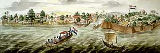


 2008/03/19 Portuguese-Eurasians hold Palm Sunday procession
Processions and traditions laced with centuries-old Portuguese and Hispanic traits come alive as Palm Sunday and Good Friday are celebrated in Malacca.
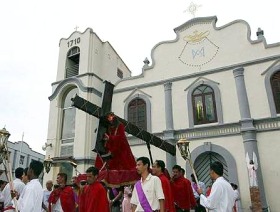
Practised by Malacca's Portuguese-Eurasian community, the celebrations are unique to the country and faithfully observed every year at St Peter's Church built in 1710.
These processions and traditions were introduced by Augustinian monks in 1587.
 |
|
| Reverent: The statue of Christ carrying the cross being taken out of the church to begin the procession. | |
The survival of these traditions can be credited to the Brothers of the Church, known as the Irmaos de Igreja in Cristao, a dialect still spoken by Portuguese descendants in Ujong Pasir.
This group is described as the oldest-surviving church organisation in South-East Asia.
There is written evidence suggesting that Irmaos de Igreja began as the Confraternity of the Holy Rosary, a Dominican tradition that traces its roots to Malacca in 1549 when Father Gaspar da Cruz founded it.
 |
|
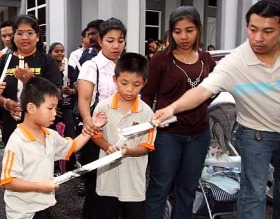
| Helping hand: A senior parishioner helping young ones light candles before joining in the procession. | |
Initial emphasis was placed to devotion to the Virgin Mary and it was only later that it took interest in the Passion of Christ following the arrival of Augustinian missionaries in the 16th century.
President of the Irmaos de Igreja, Michael Lazaroo, said the Holy Week traditions and rituals at St Peter's began on Palm Sunday and ended on Easter Sunday (March 23).
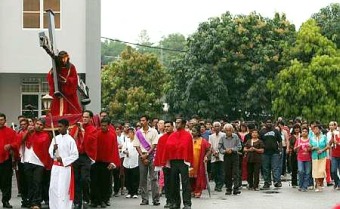
"The highlight of the week-long celebration is undoubtedly Good Friday, when thousands of Catholics and non-Christians from all over Malaysia and Singapore flock to the church for a candlelight procession."
 |
|
| Good turnout: The procession taking a turn around the church compound. | |
"Many residents of the Portuguese Settlement, who reside or work outside Malacca, return like in Christmas to be with their families and loved ones to commemorate Good Friday and Easter Sunday," Lazaroo said.
He noted that the centuries-old statues of Jesus are used and seen only during the Holy Week celebrations and are washed in wine for preservation.
He said that members of the Irmaos de Ingreja, a position passed on from father to son, were responsible for keeping the local Roman Catholic populace united during the Dutch protestant occupation of Malacca.
 |
|
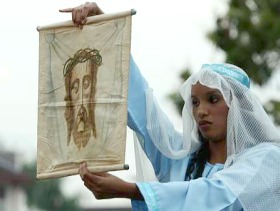
| Female presence: Rachel Thomas, playing the role of Veronica, displaying the facial imprint of Christ to the procession crowd. | |
During the Palm Sunday procession, life-size wooden statues of Christ carrying the Cross and Mother Mary of Sorrows are carried in a candlelight procession.
Throughout the procession and the Holy Week celebrations, all the statues are borne by men.
A woman's presence is allowed only by a young girl, playing the role of Veronica, who wipes the face of Jesus.
These procession scenes are repeated on Good Friday with the inclusion of three boys playing the role of tres Marias (three Marys) standing at the foot of the cross while singing a mournful Latin dirge. Also introduced during the procession is the Dead Lord statue mounted on a wooden bier.
Lazaroo said that an interesting fact to note was that it was most unusual to have an enactment of the Passion of Christ on Palm Sunday, before Good Friday, but this was the tradition at St Peter's.
Share this article with others:


Most recent articles:
[an error occurred while processing this directive]
 Previous